High oleic sunflower oil and its frying life
Why high oleic sunflower oil holds up longer at frying temperatures, how frying life is measured, and when the higher price per litre pays back.
What high oleic actually means
Conventional sunflower oil is mostly linoleic acid, a polyunsaturated fatty acid with two double bonds. It typically makes up 55 to 70% of the oil, while oleic acid, a monounsaturated fatty acid with one double bond, makes up only around 15 to 30%. That profile is good for nutrition labels but sensitive to heat and oxygen.
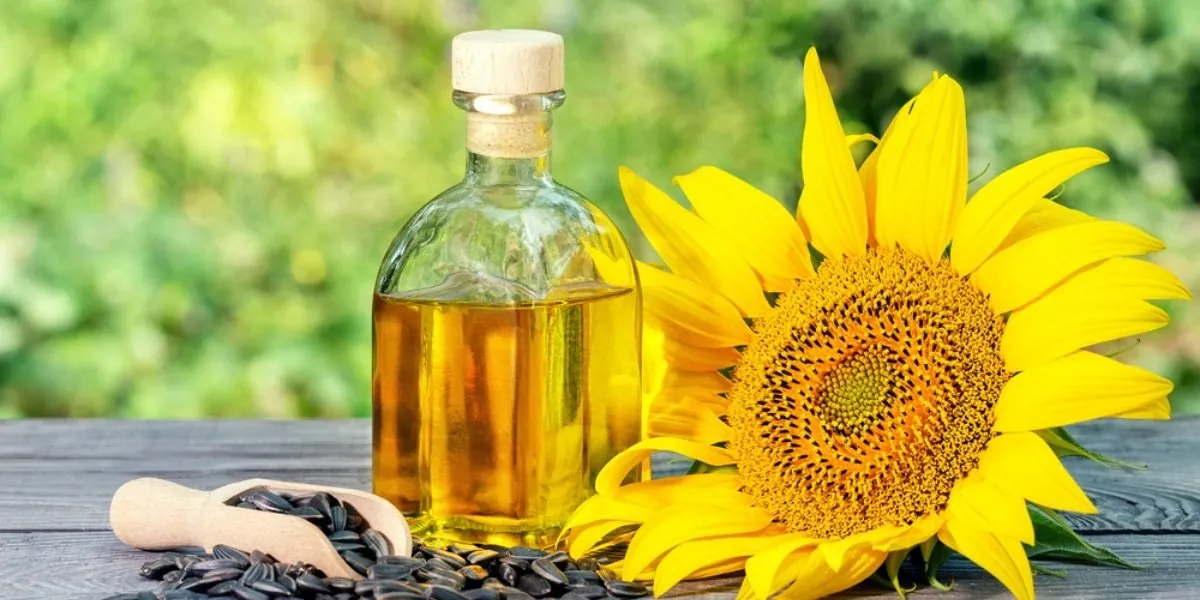
High oleic sunflower oil comes from sunflower hybrids bred to turn that ratio around. Under the Codex standard for named vegetable oils, high oleic sunflower oil contains about 75 to 90% oleic acid, with linoleic acid usually below 15%. Between the two sits mid oleic sunflower oil, with roughly 43 to 72% oleic acid. These are conventionally bred hybrids, and the seed is grown, stored and crushed separately so the profile is not diluted by standard seed.
The oil is usually refined for frying, which gives a neutral taste and a high smoke point. It looks and tastes the same as refined sunflower oil; the difference only shows up after hours in the fryer.
Typical fatty acid profiles
Approximate ranges based on Codex and common trade data. Each lot has its own analysis.
| Oil | Oleic acid (C18:1) | Linoleic acid (C18:2) | Linolenic acid (C18:3) | Saturated fats |
|---|---|---|---|---|
| Standard sunflower | 15-30% | 55-70% | Below 0.5% | About 10-13% |
| Mid oleic sunflower | 43-72% | 18-45% | Below 1% | About 9% |
| High oleic sunflower | 75-90% | 2-17% | Below 1% | About 7-10% |
| Rapeseed (low erucic) | 51-70% | 15-30% | 5-14% | About 6-8% |
| Soybean | 17-30% | 48-59% | 4.5-11% | About 14-16% |
Linolenic acid, with three double bonds, oxidises fastest of all. That is why rapeseed and soybean oils for frying are often blended or chosen from low-linolenic varieties.
Why oleic acid survives the heat
Frying oil breaks down mainly through oxidation, and oxidation starts at the double bonds of fatty acids. The weak point is a carbon atom sitting between two double bonds, which is present in linoleic and linolenic acid but not in oleic acid. Under the same conditions, linoleic acid oxidises roughly an order of magnitude faster than oleic acid, and linolenic acid faster still.
So when most of the oil is oleic acid, every step of degradation slows down. Fewer peroxides form, fewer of them split into the volatile compounds that cause off smells, and fewer molecules link up into the polymers that make oil thick, dark and foamy. The oil also leaves less of the sticky, varnish-like film on fryer walls and baskets.
Hydrolysis is a separate process. Water from the food splits triglycerides into free fatty acids, and that happens to every oil, high oleic or not. This is why good fryer practice still matters, as described below.
How frying life is measured
Frying life is the time or number of frying cycles before the oil has to be discarded. The most widely used measure is total polar materials (TPM or TPC), the share of breakdown products in the oil. Many European countries set a legal or recommended discard limit in the range of 24 to 27% polar materials. Handheld TPM meters give a reading in seconds and are now common in professional kitchens.
Other signs support the meter: free fatty acid test strips, colour, foam that does not settle, smoke at normal frying temperature and a sharp or fishy smell transferred to the food. A kitchen that discards oil on a fixed weekday, regardless of use, is almost certainly either wasting good oil or serving food fried in spent oil.
To compare oils fairly, run them in the same fryer, with the same menu and the same filtering routine, and log the TPM reading every day until the limit is reached. That gives you your own number, which is worth more than any figure in a brochure. Write down the top-up volume as well, since it changes the result more than most kitchens expect.
What the gain looks like in practice
In most comparisons, high oleic sunflower oil reaches the discard limit later than standard sunflower oil under the same conditions. Figures of around one and a half to two times longer are often quoted, but the real result depends heavily on the menu, temperature, filtering and how much fresh oil is added through topping up. A fryer with high turnover, where the food absorbs a lot of oil and fresh oil is added daily, sees a smaller difference than a fryer that runs long hours with little turnover.
Longer frying life is not the only benefit. Food tastes the same on day four as on day one for longer, there is less fryer cleaning, and fewer oil changes mean less handling of hot oil by staff. For chains, a more stable oil also makes the taste of the product more consistent between outlets.
High oleic oil is also a simple way to avoid partially hydrogenated frying fats, which were once used for stability but contain trans fats, and to reduce saturated fat compared with palm-based shortenings.
A simple payback calculation
The right comparison is cost per frying day, not price per litre. Take a hypothetical kitchen with one 20 L fryer that changes standard sunflower oil every three days and tops up about 3 L a day. Over a 30 day month that is ten full changes of 20 L plus 90 L of top-up, around 290 L in total.
Now assume a high oleic oil in the same fryer reaches the discard limit after five days instead of three. That is six full changes plus the same 90 L of top-up, around 210 L a month. In this example the kitchen buys about 28% less oil, so a high oleic oil priced up to about a third higher per litre would still cost the same or less per month, before counting labour, cleaning and waste collection.
Your own numbers will differ, which is the point: log a month on your current oil, then a month on the alternative, and do the sum with real figures. The top-up volume matters a lot, because food absorbs oil at the same rate whichever oil you use.
When it is not the right choice
The premium per litre has to pay back. A small cafe that fries a few portions a day and changes oil for hygiene reasons rather than breakdown may not see a return. The same goes for fryers that are overheated, left on at full temperature during quiet hours or never filtered: abuse shortens the life of any oil, and high oleic oil cannot fix poor practice.
A blend can be the middle ground. Blends of high oleic and standard sunflower oil, or of sunflower and rapeseed oil, sit between the two in price and stability. For many mid-volume kitchens, that is the best value. It also gives a chain one more option when seed prices move, without changing fryer routines or retraining staff.
Habits that protect any frying oil
A stable oil gives you more room for error, but these routines decide most of the frying life in any kitchen.
Most deep frying works at about 170 to 180 °C. Every extra 10 °C speeds up breakdown noticeably.
Crumbs and batter burn and speed up degradation. Filter at the end of each service, or more often with breaded products.
Salt and seasonings falling into the oil speed up breakdown. Season food away from the fryer.
Turn the fryer down or cover it during quiet periods. Hot oil exposed to air oxidises even when nothing is being fried.
Use a TPM meter and discard at your limit, not by the calendar.
Our high oleic range
Our farms grow high-oleic sunflower seeds alongside standard sunflower, rapeseed and soybean, and we process them in our own facilities. For professional kitchens we supply SUNFRY High Oleic Prime C4, a deep frying high oleic sunflower oil, and the Deep Frying High Oleic Blend C2 under the SUNFRY Chef's Choice line, in 20 L bag-in-box and HDPE jerry cans. The full professional deep-frying solutions range runs from 5 to 20 L packs and includes sunflower, rapeseed, soybean and blended oils.
For food manufacturers and distributors, refined high oleic sunflower oil is also available for bulk and bottled supply. Retail chains can add a high oleic SKU to their own brand through our private label bottling services, in bottles from 850 ml to 10 L. All frying solutions have a shelf life of up to 24 months at 6 to 30 °C.
When your oil reaches the end of its life, it still has value. Spent frying oil is a raw material for biodiesel, and used vegetable oil recycling keeps it out of drains.
Test high oleic oil in your own fryers
Tell us your fryer volume and menu, and we will suggest a high oleic oil or blend and the right pack size for a trial.
Written by the UKR AGROSUN OIL sales and production team.