Rapeseed oil vs sunflower oil - which one to choose
Canola oil vs sunflower oil compared by fat profile, frying life, taste and shelf life. See when rapeseed or sunflower oil is the better buy.

What the names rapeseed, canola and sunflower oil mean
Below we compare rapeseed (canola) oil and sunflower oil from a buyer's angle, looking at fat profile, cooking performance, storage, labelling and supply. We grow, press and refine both crops in Ukraine, so this is the same comparison we walk customers through before a contract.
Rapeseed oil comes from Brassica napus, the crop that turns fields bright yellow in May across Europe, Ukraine and Canada. The rapeseed of fifty years ago was a different plant in one important way. Its oil was rich in erucic acid, which food law now restricts, so breeders worked it out of the seed. Every food-grade variety grown today is a low-erucic one.
"Canola" is a Canadian coinage from the 1970s for those new low-erucic seeds, and North America kept it. Chemically there is nothing to separate canola oil from food-grade rapeseed oil. A buyer in Toronto will ask for canola and a buyer in Hamburg for rapeseed oil, but they are ordering the same product. In the EU, Commission Regulation (EU) 2023/915 allows no more than 20 g of erucic acid per kg of vegetable oil.
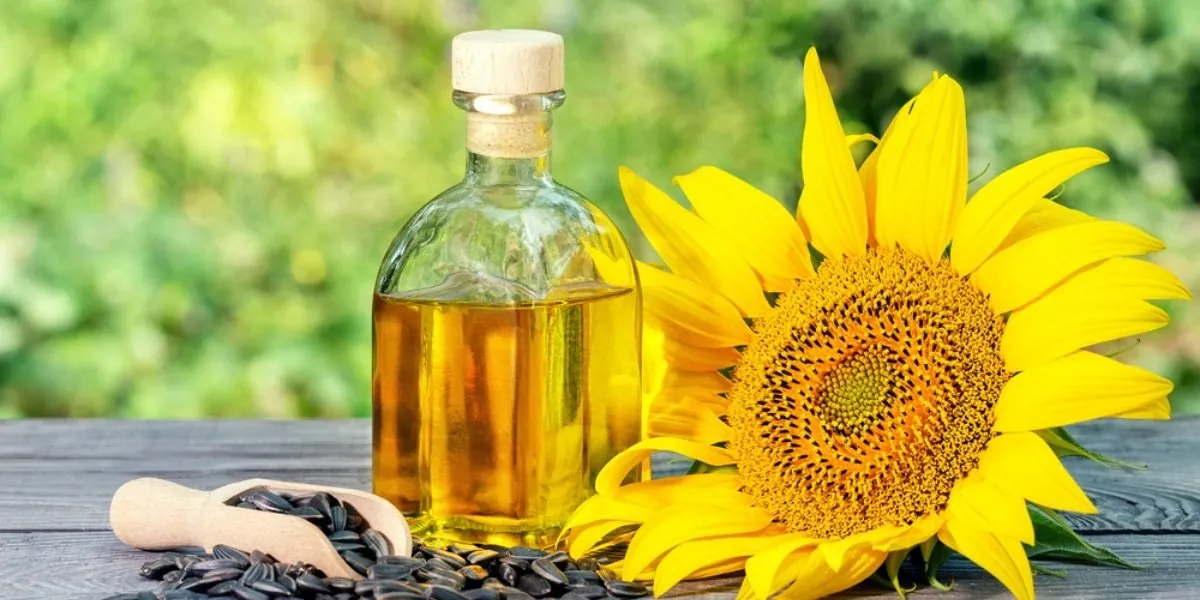
Sunflower oil is pressed from Helianthus annuus seed and reaches the market in two main types. Classic, or linoleic, sunflower oil is what most kitchens have on the shelf. The high oleic type comes from sunflower hybrids selected for a very different fat make-up, and in a hot fryer you can tell the difference within days.
Fatty acids in rapeseed and sunflower oil
Look at the fatty acids and most of the practical differences explain themselves. We use the ranges from the Codex Alimentarius standard for named vegetable oils (CXS 210-1999), the reference most contracts and lab reports follow.
Classic sunflower oil
This is an omega-6 oil first of all. Linoleic acid takes up somewhere between 48% and 74%, oleic acid between 14% and 39%. There is next to no omega-3. Saturated fat lands in the 8-14% range.
Rapeseed (canola) oil
Here oleic acid is in charge, at 51-70%. Linoleic acid adds 15-30%, and there is 5-14% alpha-linolenic acid, the plant omega-3 that sunflower lacks. Saturates come in around 7%. You will struggle to find a common cooking oil with less.
High oleic sunflower oil
Oleic acid goes up to 75-91% and linoleic acid falls to 2-17%. On paper that looks a lot like olive oil.
Oxygen goes after polyunsaturated fat first, whether the oil sits in a hot pan or in a half-empty tank. Classic sunflower oil carries the most polyunsaturated fat. Rapeseed has less linoleic acid, yet its omega-3 is even quicker to oxidise once the temperature climbs. High oleic sunflower oil has the least to lose, which is why it lasts longest.
Taste, colour and appearance
Two refined samples are hard to tell apart in a glass. Both oils come out pale yellow and close to odourless, and in a dressing even a trained panel would have trouble picking one from the other. Before refining, though, nobody would confuse them.
Cold pressed sunflower oil is golden and smells of roasted seeds. Cold pressed rapeseed oil is darker, sometimes with a greenish hue from chlorophyll, and carries a grassy, faintly nutty taste with a hint of cabbage, its botanical cousin. In some shops it sits on the premium shelf as a salad oil. Elsewhere people try it once in a frying pan and go back to sunflower.
Refining removes most of these differences. Bleaching pulls out the colour, deodorisation removes the smell, and winterisation stops the oil from clouding in the cold. If nobody is supposed to taste the oil in your product, either refined grade is fine.
Rapeseed vs sunflower oil for frying
High oleic sunflower oil wins on frying life against both of the others, simply because oleic acid holds up well at 170-180 °C. The contest between classic sunflower and rapeseed oil is closer.
Rapeseed has the edge on thickening. Less linoleic acid means slower polymerisation, so the oil in the basket stays thin and light a bit longer than classic sunflower. Its weak spot is the omega-3. After many hours of frying, rapeseed oil can start to smell fishy or like fresh paint, a known effect of oxidised linolenic acid. Classic sunflower oil does not develop that smell, but it goes dark faster. A kitchen that fries in short bursts and changes oil often will be fine with either. A kitchen that runs fryers all day is better off with high oleic oil or a dedicated frying product.
Blending is the compromise many buyers settle on. We make SUNRAP from sunflower and rapeseed oil, and RAPESEED FRY Chef's Choice is our rapeseed oil for restaurant fryers. You will find both under professional deep-frying solutions. We wrote about smoke points and fryer routines separately, in how to choose a deep frying oil for a restaurant.
Which oil suits mayonnaise, dressings and bakery
Mayonnaise, sauces and dressings can be made with either refined oil. What tips the decision is usually money, the label, and what the end customer is used to seeing. Switching between them means some recipe work on viscosity and taste, nothing more dramatic.
Some points worth weighing:
- With rapeseed oil, a brand can talk about plant omega-3 on the pack, as far as local labelling law allows.
- Where sunflower oil is the everyday cooking oil, shoppers reach for it out of habit, and a sunflower base is an easy sell.
- Sunflower oil is high in vitamin E (alpha-tocopherol), an antioxidant that protects the oil as well as adding to the nutrition panel.
- For bakery fats and shortening, both work as the liquid base. Structure comes from harder fats blended in.
Shelf life and storage
Stored properly, refined rapeseed and refined sunflower oil last about equally long. We give our bottled oils up to 24 months at 6-30 °C. Heat, light and air cut into that for both, and rapeseed, with its omega-3, is the one that suffers a little more on a sunny shop shelf.
Temperature brings in a second issue. Sunflower seed hulls leave waxes in the oil, and without winterisation the oil turns hazy as soon as it gets cool. Rapeseed oil has far less wax to begin with, but a winterised lot still looks better after a night in an unheated warehouse. Buying for a northern market or a long winter haul? Make sure the specification says winterised.
Health claims and labelling
Next to butter, lard or palm oil, rapeseed and sunflower oil are both low in saturated fat, and most of what they contain is unsaturated. WHO advice, and plenty of national food guides, say to cook with unsaturated fats in place of saturated ones. Both oils fit that advice.
Between the two, rapeseed oil has less saturated fat and a real amount of plant omega-3, which few common oils can offer. Classic sunflower oil brings omega-6 linoleic acid and plenty of vitamin E. The high oleic type, as the numbers above showed, behaves more like olive oil.
Printing such points on a label is a separate question. Nutrition and health claims are tightly regulated, in the EU by Regulation (EC) No 1924/2006, and each country words things its own way. On a label mock-up, "source of omega-3 fatty acids" or "high in unsaturated fat" can pass for a harmless extra line. Get a regulatory consultant in the target country to sign it off before the labels go to print. For personal diet advice, please talk to a doctor or dietitian rather than to an oil supplier.
Supply, price and seasonality
Price decides a lot of these deals, and price follows the harvest. Ukrainian farms cut winter rapeseed in early summer, while sunflower harvesting starts in September. New-crop rapeseed oil is therefore on the market a good three months ahead of new-crop sunflower oil. Ukraine is also one of the two largest sunflower oil exporters in the world, so sunflower supply stays deep from one season to the next.
Rapeseed oil is a smaller market. Ukraine sells much of its rapeseed abroad unprocessed. It is crushed in other countries, so that oil never reaches the Ukrainian market. Our plant reflects the same proportion, with capacity for 67,000 t of sunflower oil a year, against 9,000 t of rapeseed oil. If you need a big rapeseed volume, talk to us soon after harvest.
How far apart the two prices are changes every year, so we price every lot on its own. When you compare offers, ask for both oils on the same Incoterm and packaging. Then work out the cost per tonne of finished sauce or per week of frying, since yield and frying life change the real number.
A quick way to decide
The list below sums up which oil usually fits which job.
- Fryers running all day: high oleic sunflower oil or a frying blend.
- Short frying, home cooking, mainstream retail: classic sunflower or rapeseed oil, whichever your shoppers already buy.
- Mayonnaise, dressings, sauces: either refined oil; rapeseed if omega-3 on the label helps you sell.
- Salad oil for the premium shelf: cold pressed rapeseed or sunflower, so taste a sample of each first.
- Biodiesel and technical use: crude rapeseed oil, the usual raw material for rapeseed methyl ester.
- Large, steady volumes through the year: sunflower oil.
Rapeseed and sunflower oil from one Ukrainian producer
UKR AGROSUN OIL is a group of farms in five Ukrainian regions growing sunflower, high oleic sunflower and rapeseed. After harvest the seed goes into our certified silos and from there to our own press and refinery. The lab checks it at intake, watches every processing step and tests the oil again before a truck is loaded.
Order refined rapeseed oil or refined sunflower oil in bulk, by 24 t tank truck or in a 20 t flexitank inside a 20' container, or bottled in PET from 850 ml up to 10 L. Bulk buyers can also take cold pressed grades of both. Retail chains can have either oil bottled under their own label. We ship on FCA, CFR, CIF, DAP or DDP terms.
Still weighing the two for a recipe or a new market? Tell us the product, the volume and where it has to go. Our sales team will recommend an oil, send the lot specification and price both options side by side.
Written by the UKR AGROSUN OIL sales and production team.